
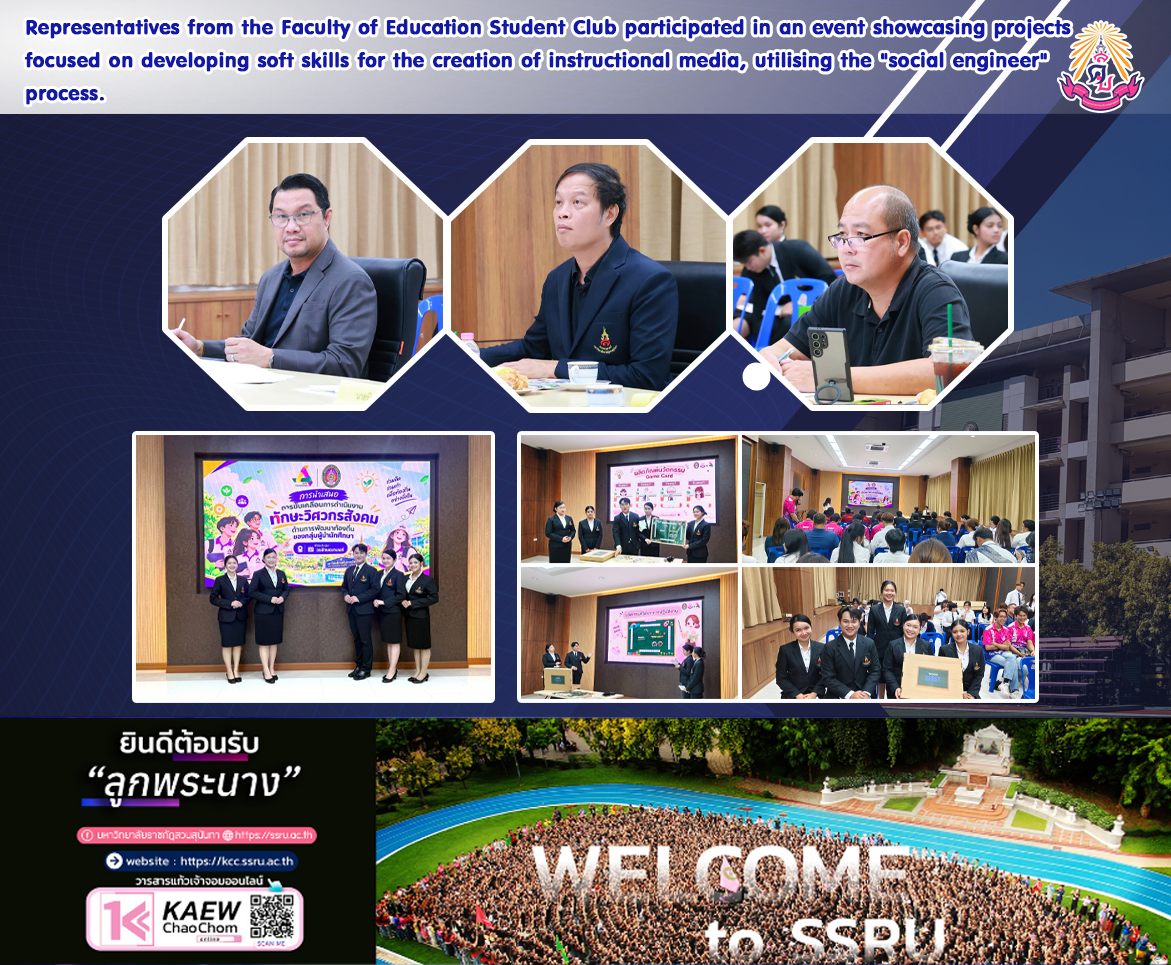
Representatives from the Student Council of the Faculty of Education, Suan Sunandha Rajabhat University, participated in a showcase event presenting projects on the development of "soft skills" for creating instructional media through the "social engineer" framework. The initiative, titled "Applying Social Engineer Skills for Community Development", falls under a broader project designed to empower student leaders in local development. Assistant Professor Panuwat Sivaskunraj, Vice Dean for Student Affairs at the Faculty of Education, Suan Sunandha Rajabhat University, served as a committee member for the event, which was organised by the university’s Student Development Division and held in the Woralaksanong Conference Room (3rd floor, Student Development Division).
The project aims to encourage students to apply their knowledge and "social engineer" skills when working with communities. It emphasises a "multidisciplinary active learning" approach, utilising a "social lab-based" model for local community development. Students from various faculties and disciplines collaborate with faculty members and local community experts to analyse and address area-specific challenges.
The initiative focuses on cultivating key competencies in students, specifically critical thinking, effective communication, coordination, and the ability to create community-based innovations. Furthermore, it promotes the use of data and systematic reasoning to analyse and solve problems. By prioritising primary data and utilising the M.I.C. Model for analysis, the approach ensures that development strategies are designed in true alignment with the specific context and needs of the community.
Furthermore, the "social engineer" process fosters engagement between students and the community, shifting the dynamic from a "provider-recipient" model to one of "co-drivers". This enables community members to participate in brainstorming, designing, and co-creating innovations—ultimately leading to community development that is self-reliant and sustainable.
The Faculty of Education was awarded 2nd Runner-up.