
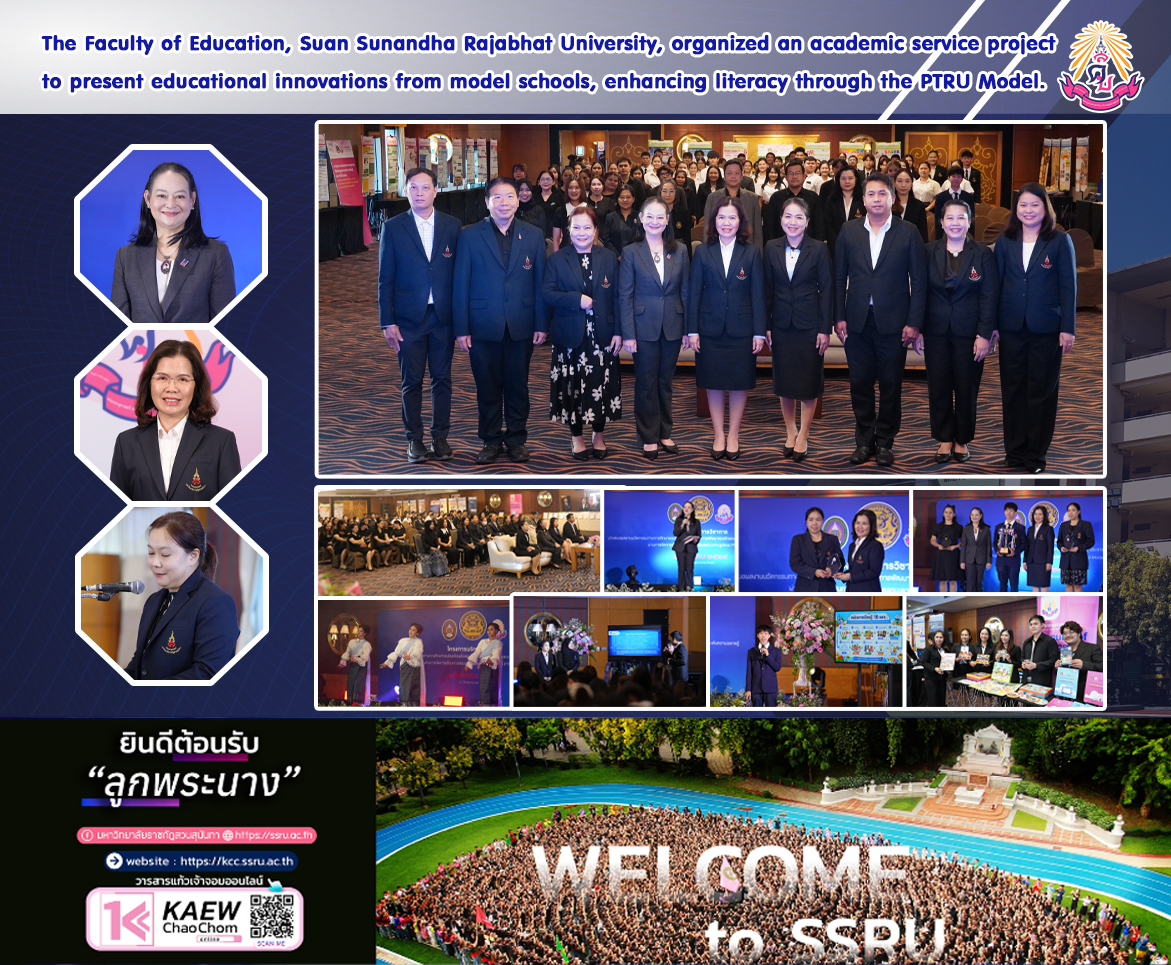
Faculty of Education, Suan Sunandha Rajabhat University Organizes an Academic Service Project to Showcase Educational Innovations from Model Schools, Enhancing Literacy through the PTRU Model
On 8 August 2026, the Faculty of Education, Suan Sunandha Rajabhat University, organized the Academic Service Project for the Presentation of Educational Innovations from Model Schools in Developing the Four Key Characteristics to Enhance Literacy through Competency-Based Instruction Using the PTRU Model at the Krung Thon Ballroom, Royal River Hotel, Bangkok. The project provided a platform for presenting, disseminating, and exchanging educational innovations developed through competency-based learning approaches, while also strengthening academic collaboration among the university, schools, and relevant organizations.
On this occasion, the President of Suan Sunandha Rajabhat University assigned Assistant Professor Dr. Kornkamol Chuchuay, Assistant to the President for Curriculum and Instruction, to represent the President and preside over the opening ceremony. Assistant Professor Dr. Kannika Piromrat, Dean of the Faculty of Education, Suan Sunandha Rajabhat University, together with university executives, faculty members, staff, school administrators, teachers, and project participants, welcomed the presiding representative and took part in the activities.
The project aimed to present and disseminate educational innovations developed by model schools in promoting the Four Key Characteristics and enhancing students’ literacy; encourage the exchange of experiences, ideas, and best practices in competency-based learning through the PTRU Model; strengthen the capacity of teachers and educational personnel to develop and apply educational innovations appropriate to the contexts of learners and schools; and establish academic collaboration among schools, the university, and relevant organizations to collectively advance educational quality in a concrete and sustainable manner.
The event featured a range of activities, including the opening ceremony, presentations of educational innovations, an exhibition showcasing innovations from model schools, knowledge-sharing sessions on competency-based learning, and the dissemination of educational best practices. These activities provided opportunities for school administrators, teachers, educational personnel, and other stakeholders to exchange knowledge and experiences, as well as explore approaches to developing educational innovations that can be effectively applied to teaching and learning and further expanded across school networks.
The event also featured an award ceremony honoring recipients of the Outstanding Educational Innovation (Best Practice) Awards. The awards recognized and encouraged teachers and educational personnel whose outstanding innovations contributed to improving the quality of teaching and learning and enhancing students’ competencies. The winner received the Prime Minister’s Trophy, reflecting the significance and value of educational innovations that can be effectively implemented to support the development of learners and educational institutions.
The implementation of this project also contributes to the United Nations Sustainable Development Goals (SDGs), particularly SDG 4: Quality Education, which seeks to ensure inclusive and equitable quality education and promote lifelong learning opportunities for all. The project supports this goal by strengthening the capacities of teachers and educational personnel, promoting competency-based learning, encouraging the development and application of educational innovations, and enhancing students’ literacy and competencies so that they can effectively apply their knowledge and skills in real-life situations.
At the same time, the project contributes to SDG 17: Partnerships for the Goals by establishing and strengthening academic partnerships among the university, schools, school administrators, teachers, educational personnel, and relevant organizations. The presentations, exhibitions, and knowledge-sharing activities served as mechanisms for transferring knowledge, exchanging best practices, and expanding educational innovations to a broader network of educational institutions.
Overall, the project represents an important mechanism through which the Faculty of Education, Suan Sunandha Rajabhat University advances its academic service mission for society by translating university knowledge and educational innovations into practical applications in schools. It promotes the systematic development of teachers, learners, and educational institutions while strengthening collaborative networks for educational advancement. The initiative is aligned with SDG 4: Quality Education and SDG 17: Partnerships for the Goals, contributing to sustainable educational development and the creation of a lifelong learning society.